Zi Wei Dou Shu Calculator (Purple Star Astrology)
Zi Wei Dou Shu (紫微斗数) is Chinese for “Purple Star” reckoning. Enter your birth details for a complete chart: twelve palaces, fourteen main stars, auxiliary stars and the four transformations — free, with the reading. The birth hour is set from true solar time and the timezone actually in force that year.
This is a worked example: born Kuala Lumpur, 18 February 1950, 17:00, when the clocks in Kuala Lumpur ran on UTC+7:30. Enter your own birth above to cast yours.
Born between 11pm and midnight? The clock your birthplace kept that year What’s my zodiac sign What Purple Star Astrology is
Birth details · 1950-02-18 · 17:00 · Kuala Lumpur — change
mingpan.co
Purple Star Astrology Chart Report
Prepared for
Life palace
Horse (午)
The Voice (巨门)
Body palace
Dog (戌)
Element class
Wood class three (木三局)
- Date of birth
- 1950-02-18
- Clock time
- 17:00
- Place of birth
- Kuala Lumpur
- True solar time
- 1950-02-18 16:02
- Hour branch
- Monkey hour (申时)
- Gender
- Male
Prepared 27 October 2026
Every finding in this report names the classical text it comes from. Scores and grades are computed fits against what this chart wants, not forecasts. The birth time has been corrected to true solar time using the birthplace longitude and the timezone actually in force that year.
Your chart on one screen
- Your type: The Herald (巨日), about 1 in 8 people
From: the main stars in your Self, Wealth and Career palaces, grouped the traditional way (三方) - Self palace: Ju Men (巨门) — speech, and the doubts and disputes that come with it.
From: the stars’ readings in Zi Wei Dou Shu Quan Shu (紫微斗数全书), quoted below - Birth-year transformations: Fortune (禄) on Tai Yang (太阳), in your Career palace (官禄); Power (权) on Wu Qu (武曲), in your Property palace (田宅); Merit (科) on Tai Yin (太阴), in your Spouse palace (夫妻); Trouble (忌) on Tian Tong (天同), in your Wellbeing palace (福德)
From: the four-transformation table for your birth-year stem, in Zi Wei Dou Shu Quan Shu (紫微斗数全书) - This decade: 2022–2031 runs through your Health palace (疾厄)
From: the decade limits (大限) of Zi Wei Dou Shu Quan Shu (紫微斗数全书), vol. 3; not rated, because nothing in the chart can be derived to rate them with - The year 2027: Fire Goat (Ding Wei, 丁未) falls on your Parents palace (父母)
From: Zi Wei Dou Shu Quan Shu (紫微斗数全书), vol. 3, on the year’s palace - Birth time: 17:00 on the clock was 16:02 true solar time (−58 min): Monkey hour (申时), not Rooster hour (酉时), so the hour pillar is different
From: this site’s correction, from your birthplace’s longitude and the clock it actually kept that year
Each line is set out in full below, with the working and the source’s own words.
This chart
The Herald
about 1 in 8 peopleThe type that works by being heard. Reads as getting things done through talking, persuading and being visible, rather than through rank or through what has been saved up.
Named after the Voice and Sun stars (Ju Ri, 巨日), which turn up most in the three parts of your chart about you, your money and your work.
Self: the palace that describes you
Wealth and Career: with Self, the three your type is read from
Your main star
The Voice (巨门)
Speech, and the doubts and disputes that come with it.
The Voice in every palace
It sits in your Self palace: the part of the chart that describes you.
Your day master
Yang Wood (甲) — the Great Tree
Stands tall, principled, slow to bend.
From BaZi, the other system on this site: the element of the day you were born, which everything else is read against.
Your month pattern
The Indirect Wealth pattern (偏财格)
Money that comes sideways rather than by salary — the uneven kind.
Also from BaZi: set by the month you were born in.
Your 2027
2027 is the Fire Goat or Sheep year (Ding Wei, 丁未). Read against your own chart, by BaZi:
Fire Goat (丁未)
2027
Very goodWhat the year's two characters bring
- Stem Yin Fire (丁) — Fire wanted
- Branch Goat (未) — Earth wanted
- hidden Yin Earth (己) — Earth wanted
- hidden Yin Fire (丁) — Fire wanted
- hidden Yin Wood (乙) — Wood unwanted
What it does to your natal pillars
This year forms no clash, harmony, punishment or harm with your natal branches.
The band above is how well this year's elements fit what your chart wants. It is a computed fit, not a forecast. No source work grades a year on a scale — this grade is computed here, and the method page sets out how.
Your 2027 in full, with your luck decades and the years around it
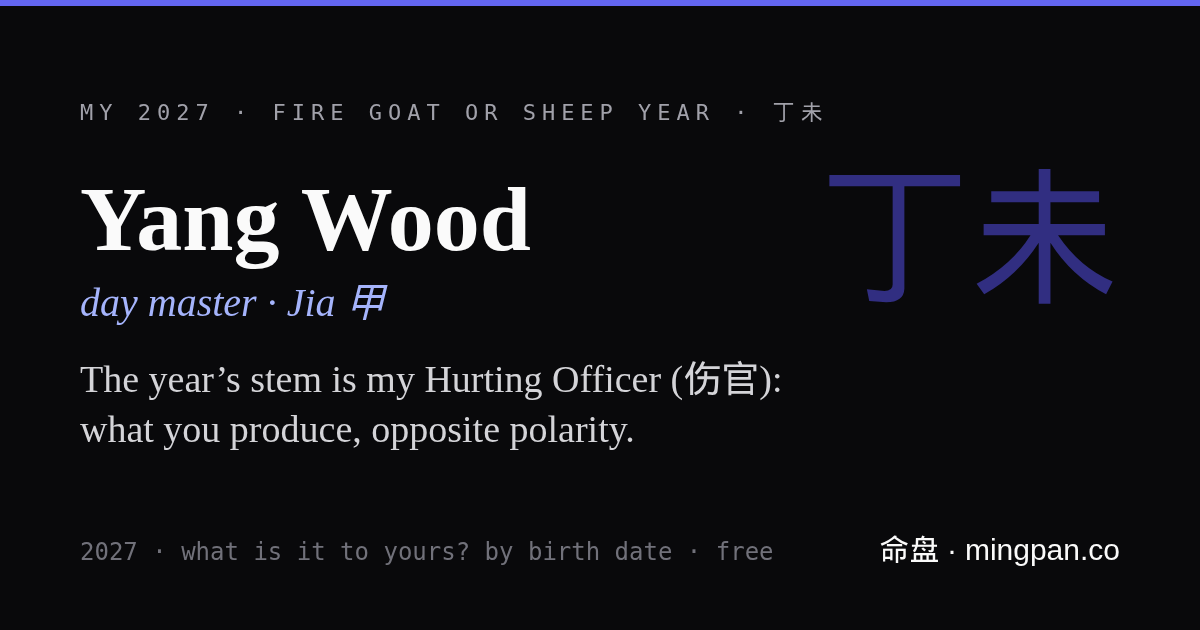
The link carries your day master only, which one person in ten shares, never your birth. The card is dated and says one thing: what the year’s stem is to that day master.
Coming back to it
- Every day: bookmark this link. Each day it sets that day against this chart. It carries your birth, as chart links here do, so keep it for yourself rather than sending it on.
- 2027, month by month:
The twelve BaZi months that begin in 2027: the solar term that opens each, its pillar, and this site’s rating of how its elements suit your chart (a lookup, not a forecast). Your browser makes the file on this page; your birth is not in it.
About your birth time
You entered 17:00; the true solar time is 16:02, which falls in Monkey hour (申时). This time, today’s timezone gives the same two-hour period (时辰) — so this chart agrees with the one you would get elsewhere.
Why the sun and the clock differ by 58 minutes: Kuala Lumpur lies west of 112.5°E, the line its clocks were set to in 1950 (UTC+7:30), so the sun runs behind the clock there: −43.2 min. The time of year shifts it by another −14.4 min.
How to read this. Twelve palaces, one per area of life. Whichever stars land in a palace colour how that area plays out. The one marked Self is the palace that describes you.
Largest names are the main stars; smaller and greyer are auxiliary and minor ones. The small word after a star (Exalted, Strong, Fallen) is how well placed it is. Coloured chips are the four transformations your birth year applies. The numbers bottom-left are the decade that palace governs.
Hover or tap any term for its Chinese name.
True solar time
1950-02-18 16:02
Shichen
Monkey hour (申时)
Element class
Wood class three (木三局)
Four pillars
Metal Tiger, Earth Tiger, Wood Monkey, Water Monkey (庚寅 戊寅 甲申 壬申)
How firm is this two-hour period (时辰)
Firm. The corrected time is 58 minutes clear of Rooster hour (酉时) — the time you entered would have to be wrong by more than that before this became a different chart. (precision not stated, so this assumes a time rounded to the nearest half hour)
What the source itself says about fixing the hour
The Rat (子) and Pig (亥) hours are the hardest of all to settle, and want careful working out. The Rat hour runs to ten marks: the earlier marks belong to the previous night's Pig hour, and the later marks to today's Rat. In overcast or rainy weather one must use the compass to fix the true hour — for if it is out, the chart is not accurate.
如人生子亥二时最难定,准要仔细推祥,如子时有十刻,上午刻属昨夜亥时,下午刻属今日子时,如天气阴雨之际,必须罗经以定真确时候,若差讹则命不准矣。
Zi Wei Dou Shu Quan Shu (紫微斗数全书), vol. 3 — On Fixing the Birth Hour Exactly (论人生时要审的确). A Ming text setting the requirement itself: get the hour wrong and the chart is not accurate. That is the whole reason this site corrects to true solar time using the timezone actually in force on your birth date.
Not sure of your birth time at all? See all twelve for this date
What the chart says
The findings
Soul palace, named formations, where the four transformations fell.
The four areas your birth year marked
Your birth year permanently changes four stars. Whichever part of life each one lands in gets marked in a particular way.
Career
Fortune (化禄)Marks work as easy ground. Read as positions and openings that find the person rather than the reverse.
What does this palace cover?
Work and standing. Not only employment — whatever you are known for doing.
How this reading is put together
The source, on this star in this palace: 太阳入庙文武为良,不见羊陀火铃吉,太阴同贵显,左右昌曲魁钺同更君科禄权,定居一品之贵。 — Well placed, good in civil or military office; fortunate when the Blade, Millstone, Flare and Ember (羊陀火铃) are absent. With the Moon (太阴), honoured and prominent. With the two Aides (左右), the Scholar and the Artist (昌曲), the two Patrons (魁钺) and the Merit transformation (化科), the Fortune transformation (化禄) or the Power transformation (化权), rank of the first order. source
What the work says the Fortune transformation (化禄) is
The god of blessing and virtue. Holding the Self or the Career palace, and meeting the Merit transformation (化科) and the Power transformation (化权), it certainly makes a great minister's post. A lesser limit meeting it means money coming in and the gladness of entering office. In a ten-year period, favourable and auspicious beyond doubt; and even with harsh stars arriving, or the Blade (擎羊), the Millstone (陀罗), the Flare (火星) and the Trouble transformation (化忌) shining across, it is not harmful. In a woman with benefics gathered, the wife of a titled man. When a limit meets it, dignity within and without; with malefics gathered, ordinary.
希夷先生答曰:禄为福德之神。守身命官禄之位,科权相逢必作大臣之职。小限逢之主进财入仕之喜。大限十年吉庆无疑,恶曜来临并羊陀火忌冲照,亦不为害。女人吉凑作命妇,二限逢之,内外威严,杀凑平常。
Zi Wei Dou Shu Quan Shu (紫微斗数全书), vol. 1 — What does the Fortune transformation govern? (问化禄星所主若何?)
The star itself: The Sun (太阳) — the sun itself — giving out, visible, and read as the axis of career and standing. In a man's chart it stands for the father, in a woman's for the husband.
What a Fortune transformation (化禄) does: eases it and finds gain inside it — the star still does what it does, but smoothly and to some profit
「太陽星屬火,日之精也…在數主人有貴氣,能為文為武…乃官祿之樞機。男作父星,女為夫主。」 — Questions and Answers on the Stars (諸星問答論), Zi Wei Dou Shu Quan Shu (紫微斗數全書)
The Sun with Fortune (太阳化禄) · The Sun in Career
Property
Power (化权)Marks the household as where authority sits. Read as the decisions about home and property being one's own.
— but this palace also holds a difficult star at full strength, which the tradition reads as undercutting it.
What does this palace cover?
Home, property, and the household — what you keep and where you keep it.
How this reading is put together
The source, on this star in this palace: 武曲单居旺地,得祖父大业,陷地退后方成,破军大耗同破荡家产,有也不耐久,天相同先见破后方有,七杀同心不欲,天府同守见成家业,贪狼同晚置,见火铃星同极美,田产茂盛,同空劫有进有退。 — Alone and well placed, a great estate from the father. Badly placed, it comes only after loss. With the Disruptor (破军) and the Great Drain (大耗), the family property is scattered, and what there is does not last. With the Minister (天相), loss first and property after; with the General (七杀), no appetite for it; with the Treasury (天府), a household already made is kept; with the Wolf (贪狼), acquired late. Meeting Fire (火) or the Ember (铃), excellent — property flourishing. With the Void and the Plunder (空劫), in and out. source
What the work says the Power transformation (化权) is
The star of authority, the god that holds judgement over life and death. Holding the Self, and meeting the Merit transformation (化科) and the Fortune transformation (化禄), one goes out a general and returns a minister. Merit and the Power transformation (化权) meeting means writing that crowns the age, admired by everybody. A lesser limit meeting it is nothing but favourable. A ten-year period means the will is carried through. But meeting the Blade (擎羊), the Millstone (陀罗), the Great Drain (大耗), the Envoy (天使), the Plunder (地劫) or the Sky Void (天空), slander is listened to and trouble follows: official penalty and demotion. In a woman it means her aims are met within and without, and she may be the wife of a titled man. For a monk, charge of a mountain and a teacher's title.
希夷先生答曰:权星掌判生杀之神。守身命科禄相逢出将入相。科权相逢必定文章冠世,人皆钦仰。小限相逢,无有不吉。大限十年,必然遂志。如逢羊陀耗使劫空,听谗贻累,官灾贬谪。女人得之内外称志,可作命妇。僧道掌山林有师号。
Zi Wei Dou Shu Quan Shu (紫微斗数全书), vol. 1 — What does the Power transformation govern? (问化权星所主若何?)
The star itself: The Iron (武曲) — the wealth star — master of the money palace (財帛宮主). hard and decisive (性剛果決), quick to both anger and favour. Effective rather than warm; with the Disruptor (破军) the text says money arrives and empties.
What a Power transformation (化权) does: intensifies it and puts you in charge of it — more of the star, and more of it under your hand
「武曲北斗第六星,屬金,乃財帛宮主…主於人,性剛果決,有喜有怒,可福可災。」 — Questions and Answers on the Stars (諸星問答論), Zi Wei Dou Shu Quan Shu (紫微斗數全書)
The Iron with Power (武曲化权) · The Iron in Property
Spouse
Merit (化科)Marks partnership as a source of standing. Read as a match that looks well from outside.
What does this palace cover?
Marriage and the primary close partnership. If you are unmarried it is read through how close partnership works for you generally, not as a prediction that one is coming.
How this reading is put together
The source, on this star in this palace: 太阴入庙男女皆贵美夫妇,加昌曲极美,加羊陀火铃空劫耗忌,不克主生离,太阳同谐老,夫同同内助,天机同美好宜少年。 — Well placed, both partners fine and well matched. With the Scholar and the Artist (昌曲), better still. With the six malefics, drain (化耗) or the Trouble transformation (化忌), if not harm then parting while both live. With the Sun (太阳), growing old together; with the Blessing (天同), a helpmeet; with the Strategist (天机), good-looking and suited to marrying young. source
What the work says the Merit transformation (化科) is
The examination star of the upper world, governing the brush and the page. Holding the Self and meeting the Power transformation (化权) and the Fortune transformation (化禄), the honour of a chief minister. Meeting harsh stars it still makes a fine scholar, fit to be a model to a crowd of talents. In a woman with benefics in trine, honour and a title. Even with the four malefics breaking in, wealth and rank. With the Merit (科) star in trine or shining across, read it the same way.
希夷先生答曰:科星上界应试,主掌文墨之星。守身命权禄相逢宰臣之贵。如逢恶曜亦为文章秀士,可作群英师范。女命吉拱,主贵封赠。虽四杀冲破,亦为富贵。与科星拱照冲同论。
Zi Wei Dou Shu Quan Shu (紫微斗数全书), vol. 1 — What does the Merit transformation govern? (问化科星所主若何?)
The star itself: The Moon (太阴) — transformed nature: wealth of the accumulating kind (富). Master of the Property (田宅) palace, and the counterpart to the sun. The text reads it as clever and handsome, refined and gentle (聰明俊秀,端雅純祥).
What a Merit transformation (化科) does: makes it visible and gives it a name — the star's workings become something you are known for
「太陰乃水之精,為田宅主,化富,與日為配…其為人也聰明俊秀,其稟性也端雅純祥。」 — Questions and Answers on the Stars (諸星問答論), Zi Wei Dou Shu Quan Shu (紫微斗數全書)
The Moon with Merit (太阴化科) · The Moon in Spouse
Wellbeing
Trouble (化忌)Marks peace of mind as the costly area. Read as a mind that does not settle on its own.
What does this palace cover?
Inner life: what you value, what you enjoy, and whether the mind settles.
How this reading is put together
The source, on this star in this palace: 天同快乐有福有寿,巨门同多忧少喜,太阴同享福,天梁同清闲快乐。 — Gladness, blessing and long life. With the Voice (巨门), much worry and little joy; with the Moon (太阴), blessing; with the Elder (天梁), leisure and gladness. source
What the work says the Trouble transformation (化忌) is
The god that meddles in everything. Holding the Self, a life that does not run smooth. A lesser limit meeting it means a year that falls short; a ten-year period, regret. When the two limits and the year cross on it, stumbling for certain. A man of letters does not last under it; a soldier, though he meets official trouble and quarrelling, is not much hindered. For a merchant or a craftsman, none of it profits. Even meeting the Emperor star (紫微), the Treasury (天府), the Scholar (文昌), the Artist (文曲), the Left Aide (左辅), the Right Aide (右弼), the Merit transformation (化科), the Power transformation (化权) and the Fortune transformation (化禄), if the Trouble transformation (化忌) shares the palace and the four malefics are there too, money made is not good and a name is not achieved. Meeting the four malefics alone, with the Great Drain (大耗), the Envoy (天使), the Plunder (地劫) or the Sky Void (天空), it means running about and carrying an ailment. For a monk, moving on and returning to lay life. In what you undertake, ask only for seven parts of it.
希夷先生答曰:忌为多管之神。守身命一生不顺,小限逢之一年不足,大限十年悔吝。二限太岁交临,断然蹭蹬。文人不耐久,武人纵有官灾口舌不妨。虽商贾技艺人,皆不宜利。如会紫府、昌曲、左右、科权禄,与忌同宫又兼四杀共处,即发财亦不佳,功名亦不成就。如单逢四杀、耗使、劫空,主奔波带疾。僧道流移还俗。处事只求七分。
Zi Wei Dou Shu Quan Shu (紫微斗数全书), vol. 1 — What does the Trouble transformation govern? (问化忌星所主若何?)
The star itself: The Blessing (天同) — transformed nature: blessing (福). Master of the Wellbeing (福德) palace — ease and contentment, and the text adds incorruptible (廉潔), and unruffled by harsh stars.
What a Trouble transformation (化忌) does: sharpens it and makes it cost — the star's difficulty is where the chart puts its weight
「天同星屬水…為福德宮之主宰…化福…為人廉潔,貌稟清奇,有機樞無亢激。」 — Questions and Answers on the Stars (諸星問答論), Zi Wei Dou Shu Quan Shu (紫微斗數全書)
The Blessing with Trouble (天同化忌) · The Blessing in Wellbeing
What your life gets built through
Your work defines you more than most people's work defines them. What you do tends to become what you are, which is a strength while it goes well.
Your Body palace (身宫) sits in Career. The Self palace is the nature you were born with; the body palace is the life you build on top of it, and the tradition holds that it weighs more heavily from around thirty-five onward.
How much you have in reserve
You have force to spare. What you need is somewhere to put it — work, money, responsibility. Things that use you up suit you better than things that build you up.
How that was worked out
- ✓You were born in a season that suits you.
in season (得令) — born in Tiger (寅), the season does back Wood - ✓The chart quietly supports you in 4 places. Not visible on the surface, but there.
rooted (得地) — rooted in 4 hidden stems - ·More of the chart drains you than helps you (3 to 4).
outnumbered (失势) — 3 supporting against 4 draining
2 of the 3 classical tests met → a strong self (身强) (strong)
Elements that help you: Fire · Earth · Metal Elements that do not: Wood · Water
These two sets are what the decade and year ratings below are scored against.
A strong Wood day master is best drained or controlled — Fire (output), Earth (wealth), Metal (authority).
This uses the support-and-restrain (扶抑) method. The other classical method, climate balancing (调候), reads the season instead — it is below, with the source's own words.
climate balancing and the useful element (调候用神) · the season you were born into
The block above uses support-and-restrain (扶抑) — how much the day master has behind it. A second method reads the temperature of the month you were born in instead: Wood born in winter wants Fire, Wood born in summer wants Water. The two often reach different answers. Both are shown; we do not pick between them.
Wood in the 1st month: early spring, the cold not yet gone. Meeting Yang Fire (丙) and Yin Water (癸) together gives both wealth and rank; Yin Water hidden in a branch with Yang Fire showing in the stems is called "cold wood turned to the sun", and is read as great wealth and rank.
The text treats this month and its neighbour under one entry.
The stems this passage names, and the words that name them:
The two methods disagree here. support-and-restrain (扶抑) puts one of those elements in your unfavourable set; Qiong Tong Bao Jian (窮通寶鑑) names it as the thing your chart is missing. Which rule takes precedence is a lineage position rather than a fact, and we do not settle it. This is not an edge case: across 1,200 charts the two conflict 45.9% of the time.
The Chinese, and where it comes from
正月甲木,初春尚有餘寒,得丙癸逢,富貴雙全。癸藏丙透,名寒木向陽,主大富貴。
Qiong Tong Bao Jian (窮通寶鑑), Ming, attributed Yu Chuntai (餘春台), a recension of Lan Jiang Wang (欄江網). source. The underlying work is long out of copyright; this particular transcription is ctext.org's open wiki text, which anyone can edit and which is not an authoritative edition. Only the opening principle of each entry is used — the conditional branches that follow it are not.
Named formations
The classical texts give names to particular arrangements of stars. This chart matches the following.
Jade hidden in stone (石中隐玉格)
1.4%Jade inside plain stone. Read as worth that is not obvious early and is recognised later than it should be — but is recognised.
Not broken by malefics — none of the six difficult stars falls across your Self triangle, so this reads as the complete formation.
The Voice (巨门) in the Self palace (命宫) at Rat (子) or Horse (午). Read as worth that is not obvious early and emerges later.
Source: 「论石中隐玉格,命在子午逢巨门是也。巨门子午二宫逢,身命逢之必贵荣,更得三方科禄照。」 — Fixing the Noble Charts (定贵局), Zi Wei Dou Shu Quan Shu (紫微斗數全書)
Salary and Horse together (禄马交驰格)
10.0%Salary and Horse in one palace. Read as gain that follows movement — going out over staying put.
Not broken by malefics — none of the six difficult stars falls across your Self triangle, so this reads as the complete formation.
The Steed (天马) sharing a palace with the Hoard (禄存) — gain that comes through movement. Counting the Fortune transformation (化禄) as well pushed this to nearly one chart in six, so only the Hoard is taken.
Source: 「如与禄存同宫,谓之禄马交驰。」 — On Stars Sharing a Palace: Wealth, Rank, Poverty and Lifespan (论诸星同垣各司所宜分别富贵贫贱夭寿), Zi Wei Dou Shu Quan Shu (紫微斗數全書)
The published lists run to sixty or more. This checks the twenty-seven whose rule can be stated exactly; where a rule is vague across lineages, nothing is claimed rather than something guessed. Percentages come from sweeping 34,560 charts and are shares of birth moments, not of people.
定富贵贫贱十等论 · how the work itself grades a chart
This site does not grade charts. These three sections grade one outright, in the work's own words, and leaving them out while keeping them in the corpus was a decision about tone rather than about sources. They are shown as the Ming text's verdict, with the measured rate beside each and the ones it could not judge listed with the number that stopped them.
How a list of star names was read, and why
此篇诸论皆列星名而不言「并」「或」,故读法有二:尽在则合,或有一即合。二读相去千倍,不可以意取,乃以十四万四千盘实测定之 — 「坐命」之列读作或,「三方拱照」之列读作尽在。盖六星同坐一宫者,遍历诸盘无一,最多者三;而三方十星俱全者,万中有一,其数正合十等之分。
These sections list star names without saying whether they are required together or as alternatives. The two readings differ by a factor of a thousand, so the choice was made by measurement over 144,000 chart shapes rather than by taste: a sitting in the Self palace (坐命) list is read as alternatives, a support from the trine (三方拱照) list as a gathering. Six stars in one palace happens on no chart at all — the most any chart reached was three — while ten stars across the triangle happens about once in a thousand, which is the shape a ten-grade division should have.
None of the ten grades holds for this chart. Where nothing matches, nothing is claimed.
On Charts that Enter a Pattern (论人命入格) · does it take a formation, and is it bright
平等
level
「入庙不加吉,平等」
「又入格不化吉而化凶,只以本命吉凶多寡而断之」
And where a chart takes a formation but its four transformations (四化) are inauspicious rather than auspicious, judge it only by how much good and ill the chart itself holds.
羊陀二星总论 · where the Blade (擎羊) and the Millstone (陀罗) fall
「玉蟾先生曰:擎羊陀罗二星属火金,乃北斗浮星,在斗司奏,在数凶厄。羊化气曰刑,陀化气曰忌」
The Blade (擎羊) and the Millstone (陀罗) belong to fire and metal, drifting stars of the Northern Dipper. In the Dipper they preside over memorials; in the numbers, over calamity. The Blade transforms into punishment (刑); the Millstone into Trouble (忌), obstruction.
- 临兄弟田宅父母 in the siblings, estate or parents palace — The Blade (擎羊) · the Property palace (田宅), the Millstone (陀罗) · the Parents palace (父母)
「怕临兄弟、田宅、父母三宫」 - 与火铃为凶伴 paired with the Flare (火星) or the Ember (铃星) — The Blade (擎羊) · the Property palace (田宅)
「与火铃为凶伴只宜僧道」 fit only for the cloister - Power, the Blade and the General together (权刑合杀) the Power transformation (化权), the Blade (擎羊) and the General (七杀) together — The Blade · the Property palace (田宅)
「权刑合杀疾病官厄不免」 illness and trouble with the authorities, unavoidable
6 conditions in these sections that are not judged, and why
- On Valour (威勇论) 0 of 144,000 — Three conditions at once: a star in the Self palace (命宫), both the Power transformation (化权) and the Fortune transformation (化禄), and all four of the Emperor star, the Treasury and the two Aides (紫微天府左右) gathered in the triangle. Measured over 144,000 chart shapes it fires on none; the most any chart met was four of the five parts. Loosening it further would be writing the rule rather than reading it.
「威勇论 如武曲文昌擎羊七杀坐命宫得权禄三方又得紫微天府左右拱照主人威勇」 - On Wealth and Rank (富贵论) 0 of 144,000 — Eleven stars gathered in the triangle. No chart in 144,000 shapes holds all of them; the most any reached was nine. The list is close to the complete set of auspicious stars, which no single chart can hold.
「富贵论 如紫微天府天相禄权科太阴太阳文昌文曲左辅右弼天魁天钺守照拱冲主大富贵」 - On Poverty and Low Station (贫贱论) 0 of 144,000 — Eight malefics gathered in the triangle AND all of them dim — 诸凶并犯陷地. The most any chart managed was two of them dim at once. Brightness is fixed by which star sits in which branch, and eight cannot be dim together across one triangle.
「贫贱论 如擎羊陀罗廉贞七杀武曲破军天空地劫忌星三方四正守照拱冲诸凶并犯陷地主贫贱」 - On Monks and Priests (僧道论) 0 of 144,000 — Seven stars gathered in the triangle; the most any chart reached was five. And the Drain and the Killings (耗杀) is not defined anywhere in the work, so even with the star count loosened that half of the condition could not be judged.
「僧道论 如天机天梁七杀破军天空地劫并犯帝座紫微又或耗杀加临主为僧道」 - 贪耗流年面上刺痕 — IMPOSSIBLE natally, proved exhaustively. The Wolf (贪狼) and the Disruptor (破军) are two corners of the General, the Disruptor and the Wolf (杀破狼) triad and never share a palace — walked across all 150 combinations of the element class (五行局) and lunar day that decide where the majors fall, they coincide in none. The clause says a passing year (流年), and means it: this is a pairing that can only occur when a year brings one of them to the other, which this block does not judge.
「贪耗流年面上刺痕」 - 见日月女克夫,而夫克妇 — This fixes a woman's outcome as harming her husband because she is a woman, which is the class of clause this site does not carry — the policy is in bin/gendered.py and is applied to two other works already. The same sentence's hidden moles and moles by the eye (有暗痣、眼痣) is a claim about moles and eyes rather than about a life, and is not judged either.
「合昌曲、左右有暗痣、眼痣。见日月女克夫,而夫克妇,为诸宫之凶神」
Zi Wei Dou Shu Quan Shu (紫微斗數全書) — 定富贵贫贱十等论, On Charts that Enter a Pattern (论人命入格), 羊陀二星总论. Rates come from the same build sweep that checks the rules.
The analysis
The twelve palaces, in detail
The full working, palace by palace and star by star.
How your four landed
Which palace each transformation lands in is near enough even across the twelve. What varies is whether they land together. Yours:
Your four landed in 4 different palaces
65.3%No two share a palace, and they do not form the Self-triangle arrangement. This is the ordinary case: the weight is spread rather than concentrated, and no single area carries more than its share.
▸The whole boardYou were dealt four of forty-eight. Open to see the other forty-four.
Every cell is fixed in advance. Your birth-year stem picks which four stars transform, and where those stars sit picks the cells. Here is the whole table, with yours marked.
Self
who you are at core
Siblings
siblings, and the people alongside you
Spouse
marriage and close partnership
Children
children, and what you create
Wealth
money coming in and going out
Health
the body, and what wears it down
Travel
going out — travel, moving, elsewhere
Friends
friends and the people you work with
Career
work and standing
Property
home, property, what you keep
Wellbeing
peace of mind, and what you enjoy
Parents
parents, and anyone with authority over you
Is any cell rarer than the others?
No. Across 51,840 charts, all forty-eight cells fall between 7.8% and 8.9% — about 1 in 12, because the Self palace rotates evenly with month and hour. No cell is a rare draw. What does vary is whether your four land together.
These are shares of birth moments, not of people: a uniform sweep of the full Wood Rat (甲子) cycle, every lunar month and every double-hour. Real births are not spread evenly across months or hours.
Flying transformations
This section is about how the different areas of your life pull on each other.
Each of the twelve palaces carries its own stem, and each stem fires four transformations at whichever palaces hold the target stars. This chart has 48.
Where the chart concentrates friction
Travel (迁移)
going out — travel, moving, elsewhere
More of this chart's friction points here than anywhere else — 4 separate parts of it push on this one area. Not a warning. It is simply the part of life that will ask most of you.
4 transformations of Trouble land here, against 1 of Fortune. The Trouble transformation (化忌) is read as debt owed — the area that asks most of you.
Self-transformation
These areas spend themselves. Energy goes out of them and nothing comes back in exchange.
A palace transforming a star it already holds. Read as a leak rather than an exchange.
Which area pulls on which (11)
Read each line as: what is on the left costs you effort in what is on the right.
The transformation table follows the Zhongzhou school (中州派) lineage. Lineages differ on the Yang Earth (戊) and Yang Metal (庚) rows; this states which one is used rather than leaving it implicit.
The six difficult stars
Six stars in this system stand for obstruction. Every chart has all six — what differs is where they sit, and how well they sit there.
Where they weigh most
Children
children, and what you create
Counting its trine and opposite palace, this group holds 6 of the six, 3 of them poorly placed. Not a verdict — it means resistance is concentrated here rather than spread.
Blade and Millstone flanking Trouble (Yang Tuo Jia Ji, 羊陀夹忌) in Wellbeing
This palace is flanked by the Blade on one side and the Millstone on the other, and carries Trouble itself — something sharp ahead, something grinding behind, and the thing that costs you most sitting between them.
flanked by the Flare and the Ember (火铃夹) in Career
Caught between the two fire stars — pressure from both sides at once, one sudden and one slow.
▸Where each of the six sits
What the work says the Millstone (陀罗) is
A helper star of the northern dipper. Holding the Self: crooked in conduct, with hidden tears that never stop; hard and forceful by nature, advancing and retreating in what it does. Sudden making and sudden breaking, drifting and never settled. Sharing a palace with the Wolf (贪狼), consumption brought on by drink and appetite; with the Flare (火星) or the Ember (铃星), scabs and infection but not death. In the Health palace, a hidden illness that will not clear. For a person born in Dragon (辰), Dog (戌), Ox (丑) or Goat (未) it makes blessing; well placed, read it for money and office. A man of letters does not last under it; a soldier rises suddenly and far. Badly placed with malefics added, harm and misfortune drawn in, and life continued under a second surname.
希夷先生答曰:陀罗北斗之助星。守身命心行不正,暗泪长流,性刚威猛,作事进退。横成横破,飘荡不定。与贪狼同度因酒色以成痨,与火铃同处,疥疫不死。居疾厄,暗疾缠绵。辰戌丑未生人为福,在庙财官论,文人不耐久,武人横发高迁。若陷地加杀刑克招凶,二姓延生,
This section carries a clause fixing a woman's outcome as concubine, courtesan, maid or unchaste. It is removed here in the Chinese as well as the English, on the same footing as everywhere else on this site; the full text is at the source.
Zi Wei Dou Shu Quan Shu (紫微斗数全书), vol. 1 — What does the Millstone govern? (问陀罗星所主若何?)
What the work says the Flare (火星) is
A floating star of the southern dipper. Master Xiyi (希夷先生) sings: The Flare (火星) is a great killing general, called the killing god of the southern dipper. If it governs the Self, there is no palace it may safely come to. Its temper runs deep and poisonous, hard and strong beyond other people. The hair is often unusual and there is a scar at the lip or tooth. Meeting the Blade (擎羊) and the Millstone (陀罗) as well, certain trouble in infancy — given out to another house or raised outside, a second surname can preserve the life. This star favours the south and east and does not favour one born in the north or west. But meeting the Wolf (贪狼) and well placed, honour beyond compare: a marquis and a senior general, with achievement on the frontier. With no malefic breaking the trine, the rise begins after middle life. For a monk, much drifting, and the rule not kept in the heart. In a woman well placed, clean; harm to husband and children.
答曰:火星乃南斗浮星也。希夷先生歌曰火星大杀将,南斗号杀神,若主身命位,诸宫不可临,性气亦沉毒,刚强出众人,毛发多异类,唇齿有伤痕,更与羊陀会,襁褓必灾迍,过房出外养,二姓可延生,此星东南利,不利西北生,若得贪狼会,旺地贵无伦,封侯居上将,勋业着边庭,三方无杀破,中年后始兴,僧道多飘荡,不守规戒心,女人旺地洁,
This section carries a clause fixing a woman's outcome as concubine, courtesan, maid or unchaste. It is removed here in the Chinese as well as the English, on the same footing as everywhere else on this site; the full text is at the source.
Zi Wei Dou Shu Quan Shu (紫微斗数全书), vol. 1 — What does Fire govern? (问火星所主若何?)
What the work says the Blade (擎羊) is
A helper star of the northern dipper. Holding the Self: coarse and violent in conduct, solitary, treating kin as strangers and turning kindness into resentment. Well placed, firm and decisive, resourceful and brave, and it means authority and rank. For a person born in the north it makes blessing, and a person born in one of the four Tomb (墓) need not fear it. At Rabbit (卯) or Rooster (酉) it makes trouble and disaster, with harm in the extreme. For a person born under the six Yang Wood years (六甲) or the six Yang Metal years (六庚), certain misfortune; wealth and rank, if any, do not last and the end is not good — or else a hard-working craftsman of the nine schools. With the Flare (火星), the Trouble transformation (化忌), the Plunder (地劫) or the Void (地空) breaking in, disability, leaving the ancestral home, and harm to kin. In a woman, well placed and with benefics, a first-grade chart; with malefics and the Great Drain (大耗) breaking in, mostly harm, and a low one.
希夷先生答曰:擎羊北斗之助星。守身命性粗行暴,孤单,视亲为疏,翻恩为怨。入庙性刚果决,机谋好勇,主权贵。北方生人为福,四墓生人不忌。居卯酉作祸兴殃,刑克极甚。六甲六庚生人,必有凶祸。纵富贵不久亦不善终,若九流工艺人辛勤。加火忌劫空冲破,残疾离祖刑克六亲。女人入庙加吉上局,杀耗冲破多主刑克下局。
Zi Wei Dou Shu Quan Shu (紫微斗数全书), vol. 1 — What does the Blade govern? (问擎羊星所主若何?)
What the work says the Ember (铃星) is
A helper star of the southern dipper. Master Xiyi (希夷先生) sings: the great killing the Ember (铃星) general, a follower god of the southern dipper. Falling on the Self, the character broods. The features are often unusual, and there is authority in the bearing and a name with it. Meeting the Wolf (贪狼), the frontier command in short order. Well placed, money, office and honour; badly placed, solitude and poverty. With the Blade (擎羊) and the Millstone (陀罗) gathered, the harm is far from clean: solitary, the ancestral line left, injured and carrying an ailment. For a monk, much drifting and a certain return to lay life. In a woman with no benefic, harm and few kin; a short life and hardship. This star is a great killing general and its ill cannot be checked: misfortune throughout a life, and what looks solid is hollow feeling. With the General (七杀), death in battle; with the Disruptor (破军), money and house overturned; with the Mystic (廉贞), the Blade and the Punisher (天刑), and the Plunder (地劫) or the Void (地空), weapons. Meeting the Wolf, office is unquiet too. But sitting well placed, its wealth and rank are beyond reckoning.
答曰:铃星乃南斗助星也。希夷先生歌曰大杀铃星将,南斗为从神,值人身命者,性格亦沉吟,形貌多异类,威势有声名,若与贪狼会,指日立边庭,庙地财官贵,陷地主孤贫,羊陀若凑合,其刑大不清,孤单并弃祖,残伤带疾人,僧道多飘荡,还俗定无疑,女人无吉曜,刑克少六亲,寿夭仍困贫,此星大杀将,其恶不可禁,一生有凶祸,聚实为虚情,七杀主阵亡,破军财屋倾,廉宿羊刑会,劫空主刀兵,或遇贪狼宿,官禄亦不宁,若逢居旺地,富贵不可论。
This section carries a clause fixing a woman's outcome as concubine, courtesan, maid or unchaste. It is removed here in the Chinese as well as the English, on the same footing as everywhere else on this site; the full text is at the source.
Zi Wei Dou Shu Quan Shu (紫微斗数全书), vol. 1 — What does the Ember govern? (问铃星所主若何?)
The seat verses · what the work says about this Self palace (命宫)
Volume 1 gives each branch a verse for a fitting seat and one for a broken seat, naming the stars that palace wants and, usually, the birth-year stems. Only what your chart meets is listed. The work does not score these, so neither does this.
A fitting seat · the Self palace (命宫) at Horse (午)
午宫紫府太阳同,机梁破杀喜相逢,甲丁己癸生人福,一世风光廪禄丰。
Your chart meets none of what this verse names. Where nothing matches, nothing is claimed.
A broken seat · the Self palace (命宫) at Horse (午)
子午天机丑巨铃,此星落陷果为真,纵然化吉更为美,任他富贵不清宁。
Your chart meets none of what this verse names. Where nothing matches, nothing is claimed.
A broken seat · the Self palace (命宫) at Horse (午)
午宫贪巨月昌从,羊刃三合最嫌冲,虽然化吉居仕路,横破横成到老穷。
Where your chart puts its weight
The twelve palaces are drawn the same size, but they do not hold the same amount. Main stars, transformations and difficult stars cluster — and where they cluster is where your life has the most going on.
The three loudest
Most of this chart's material sits here. Expect this part of life to be eventful — which is not the same as fortunate. A crowded palace is crowded either way.
No palace is read on its own. Each one is taken together with the two it forms a trine with and the one directly opposite — The four linked palaces (三方四正). What sits in those three colours this area as much as what sits in the area itself, and the opposite palace carries the most weight of the three.
Property
home, property, what you keepThe Iron (武曲) Adequate · The General (七杀) Exalted
The Power transformation (化权)The FlareThe Blade
What the work says the Iron (武曲) is
The sixth star of the northern dipper, Metal, and the ruler of the Wealth palace. In the same palace as the Treasury (天府) there is long life. It exercises its authority across the twelve palaces, and its ground may be Exalted (庙), Strong (旺) or Fallen (陷). In a person it means a firm and decisive nature, with gladness and anger both in it, and blessing or calamity both possible. Meeting the trapped (囚) star in the Zhen, the east (震) palace it certainly means a broken undertaking and long delay. Running with the Hoard and the Steed (禄马), wealth is made in a distant province. Sharing the palace with the Wolf (贪狼), a mean and grudging person. With the Disruptor (破军) in the country of wealth, money reaches the hand and comes to nothing. Malefics gathered make calamity; benefics gathered make good fortune. Master Xiyi (希夷先生) says: The Iron (武曲) is Metal, governing long life in heaven and wealth in the reckoning. It fears being held down and badly placed, and welcomes the Hoard (禄存) governing with it. With the Moon (太阴) it shares authority; the Treasury and the Minister (天相) are its assisting stars; Wealth and Property are its particular charge. Harsh malefics, the Great Drain (大耗) and the trapped meeting in the Zhen, the east palace, and one certainly meets wood falling and thunder striking. The Disruptor and the Wolf meeting in the Kan, the north (坎) palace, and one drowns. Meeting the Hoard and the Steed, wealth is made in a distant province. Meeting the Wolf, the early years are unfavourable — hence the saying that Iron holding the Self is no light blessing, and that a Wolf does not open out for a young man. Well placed with the peach blossom (桃花) in the same palace, it profits itself and costs others. With the General (七杀) and the Flare (火星), wealth is taken by robbery. Meeting the Blade (擎羊) and the Millstone (陀罗), solitude and harm; meeting the Disruptor, honour is hard to show. With the Disruptor in the same place, and coming into either limit, it certainly means disputes. Broadly, the Iron holding the Self makes a person firm, strong and decisive; born under Yang Wood (甲) or Yin Earth (己) the blessing is thick, and one goes out a general and returns a minister. Getting the Wolf and the Flare breaking in as well, it is certainly an honoured pattern. It likes a person born in the north-west; those born in the south-east are ordinary and do not keep the ancestral estate. With the four malefics breaking in, solitude and poverty in one form or another, and a scar lengthens the years. A woman with many benefics is an honoured wife; with malefics breaking in, solitude and harm.
答曰:武曲北斗第六星,屬金,乃財帛宮主。與天府同宮有壽,其施權於十二宮分,其臨地有廟、旺、陷宮。主於人,性剛果決,有喜有怒,可福可災。若陷囚會於震宮,必為破主淹留之舉。與祿馬交馳,發財於遠郡。若貪狼同度,慳吝之人。破軍同財鄉,財到手而成空。諸凶聚而作禍,吉集以成祥。希夷先生曰:武曲屬金,在天司壽,在數司財。怕受制入陷,喜祿存而同政。與太陰以互權,天府、天相為佐貳之星,財帛田宅為專司之所。惡殺耗囚會於震宮,必見木壓雷震。破軍貪狼會於坎宮,必主投河溺水。會祿馬則發財遠郡。貪狼會則少年不利。所謂武曲守命福非輕,貪狼不發少年郎是也。廟樂桃花同宮,利己損人。七殺火星同宮,因財被劫。遇羊陀則孤克,遇破軍難顯貴。若與破軍同位,更臨二限之中,定主是非之撓。蓋武曲守命,主人剛強果斷,甲己生人福厚,出將入相。更得貪火沖破,定為貴格。喜西北生人,東南生人平常,不守祖業。四殺沖破孤貧不一,破相延年。女人吉多為貴婦,加殺沖破孤克。
Zi Wei Dou Shu Quan Shu (紫微斗数全书), vol. 1 — What does the Iron govern? (問武曲星所主為何?)
The Iron (武曲) — Alone and well placed, a great estate from the father.
The full clause, and the Chinese it is translated from
Alone and well placed, a great estate from the father. Badly placed, it comes only after loss. With the Disruptor (破军) and the Great Drain (大耗), the family property is scattered, and what there is does not last. With the Minister (天相), loss first and property after; with the General (七杀), no appetite for it; with the Treasury (天府), a household already made is kept; with the Wolf (贪狼), acquired late. Meeting Fire (火) or the Ember (铃), excellent — property flourishing. With the Void and the Plunder (空劫), in and out.
武曲单居旺地,得祖父大业,陷地退后方成,破军大耗同破荡家产,有也不耐久,天相同先见破后方有,七杀同心不欲,天府同守见成家业,贪狼同晚置,见火铃星同极美,田产茂盛,同空劫有进有退。
What the work says the General (七杀) is
The sixth star of the southern dipper, Fire and Metal. It is the senior general within the dipper, and truly the solitary star of success and failure. In the dipper it holds the dipper's handle and governs discipline. Its authority works as Metal's spirit, and its nature is like a cold clear air. In the reckoning it suits a religious life; in the Self it certainly passes through hardship. In the Self, if the limit does not support it, life is cut short; in Career on its ground, it turns calamity into good fortune. In Children the children stand few; in Spouse the marriage bed is half cold. Meeting the Punisher (天刑) or the trapped (囚) in Property or Parents, harm to the parents and an estate hard to keep. Meeting the Punisher, the Trouble transformation (化忌) or a malefic in Travel or Health, infirmity for a lifetime — and even standing alone, the years should not be long. With the trapped in the Self, a broken arm or leg, and consumption besides. Meeting the trapped and the Great Drain (大耗) in Travel, death on the road. Coming to a weak palace the injury is a little less; falling in a truly yin palace, the trouble runs deep. The year's malefics must not be met; where the Body's malefic stars pile up at Dragon (辰) and Dog (戌), where the Body meets ill stars in an important place, where the Self meets malefics across the trine, and the year's malefics pile on again, and both limits meet it too, it means death in battle or a violent end. Joining the Sun (太阳) and the Voice (巨门) in a strong palace it is favourable; sitting on the Void (空亡) and offending the Punisher and the malefics, the trouble is not light. Where both limits join the Self and meet a malefic, even the emperor's command has no effect; clashing across the trine, even Fortune (禄) has no force. A hero of the age held down by a malefic — and here the whole thing is a dream. This is the ground of the overturned limit, and what it governs must be weighed with great care. It is an ill star of the reckoning and truly not a good one. Master Xiyi (希夷先生) says: The General (七杀) is the senior general in the dipper. Meeting the Emperor star (紫微) it is transformed to the Power transformation (化权) and brings blessing down; meeting the Flare (火星) or the Ember (铃星) it lengthens its killing force. Meeting an ill star in living ground it is certainly a butcher; meeting the Scholar and the Artist (昌曲) in an important place, the temper is stubborn and loud. The secret classic says: The General badly placed, brooding, and no blessing arises. The Self and the Body meeting it certainly pass through hardship, and either limit meeting it takes calamity and ruin. Meeting the emperor and the Fortune it can be resolved; meeting the year's malefics it meets ill. Holding the Self it advances and retreats in what it does, with gladness and anger not constant. With the two Aides (左右) and the Scholar and the Artist well placed and shining in trine, it holds the power of life and death, and its wealth and rank stand out. If the four malefics or Trouble break in, a craftsman and an ordinary person; badly placed, infirmity. A woman on strong ground commands money and authority and her will passes her husband's. For a monk it suits; and with malefics gathered, drifting and moving, and a return to lay life. The song runs: The General at Tiger (寅), Monkey (申), Rat (子) or Horse (午) — the four quarters give way to the hero. With the two Patrons (魁钺), the two Aides and the Scholar (文昌) meeting, authority and income, a high name and ten thousand measures to eat. The General badly placed is past speaking of, the ill of it like sleeping holding a tiger; and if the malefic is strong with nothing to hold it down, a young man dies badly and goes to the Yellow Springs.
答曰:七殺南斗第六星也,屬火、金。乃斗中之上將,實成敗之孤辰。在斗司斗柄,主於風憲。其威作金之靈,其性若清涼之狀。主於數則宜僧道,主於身定歷艱辛。在命宮若限不扶夭折,在官祿得地,化禍為祥。在子息,而子息孤單;居夫婦而鴛衾半冷。會刑囚於田宅、父母,刑傷父母,產業難留。逢刑忌殺於遷移、疾厄,終身殘疾,縱使一身孤獨,也應壽年不長。與囚於身命,折肱傷股,又主癆傷。會囚耗於遷移,死於道路。若臨陷弱之宮,為殘較減。若值正陰之宮,作禍憂深。流年殺曜莫教逢,身殺星辰戌迭並,身殺逢惡曜於要地,命逢殺曜於三方,流殺又迭並,二限之中又逢,主陣亡掠死。合太陽巨門會帝旺之鄉則吉,處空亡犯刑殺遭禍不輕。大小二限合身命逢殺,雖帝制也無功。三合對沖,雖祿亦無力。蓋世英雄為殺制,此時一夢南柯。此乃倒限之地,所主務要仔細推詳,乃數中之惡曜,實非善星也。希夷先生曰:七殺斗中上將,遇紫微則化權降福,遇火鈴則長其殺威。遇凶曜於生鄉定為屠宰,會昌曲於要地,情性頑囂。祕經云:七殺居陷地,沉吟福不生是也。身命二宮逢之定歷艱辛,二限逢之遭殃破敗。遇帝祿而可解,遭流殺而逢凶。守身命作事進退,喜怒不常。左右昌曲入廟拱照,掌生殺之權,富貴出眾。若四殺忌星沖破,巧藝平常之人,陷地殘疾。女命旺地,財權服眾,志過丈夫。僧道宜之,若殺湊飄蕩,流移還俗。歌曰七殺寅申子午宮,四夷拱手服英雄,魁鉞左右文昌會,權祿名高食萬鍾,殺居陷地不堪言,凶禍猶如抱虎眠,若是殺強無制伏,少年惡死到黃泉。
This section carries a clause fixing a woman's outcome as concubine, courtesan, maid or unchaste. It is removed here in the Chinese as well as the English, on the same footing as everywhere else on this site; the full text is at the source.
Home, property, and the household — what you keep and where you keep it.
Read with: Health the Emperor star and the Disruptor (紫微破军) · Siblings the Mystic and the Wolf (廉贞贪狼) · Children opposite the Treasury (天府)
Wellbeing
peace of mind, and what you enjoyThe Blessing (天同) Strong · The Elder (天梁) Fallen
The Trouble transformation (化忌)
What the work says the Blessing (天同) is
Water, the fourth star of the south, and the ruler of the Wellbeing palace. It is also said: transformed to blessing, it most welcomes meeting benefics, which help the blessing and add good fortune. It makes a person upright and clean, with a clear and unusual look. It has a hinge and a pivot in it and nothing violent; it does not fear the General (七杀) pressing on it, nor the malefics winding round it. A limit meeting it gets its ground for a life, and in all twelve palaces it is called blessing — unbroken, it is certainly good fortune. Master Xiyi (希夷先生) says: The Blessing (天同) is the southern dipper's star of added reckoning and preserved life. Transformed to the Fortune transformation (化禄) it is good; meeting benefics it is fortunate. Falling in the Self it makes a person modest and mild in temper, certainly kind and plain-spoken, accomplished with the brush, with a rare will and nothing violent in it. It does not fear the General pressing on it or the ill stars sharing its degree, and in all twelve palaces it is read as blessing. Meeting the two Aides (左右), the Scholar (文昌) and the Elder (天梁) it is honoured and prominent. It likes those born under Yang Water (壬), Yin Wood (乙) or Yang Fire (丙), and gets its ground at Snake (巳) and Pig (亥). It does not suit one born under the six Yang Metal years (六庚) sitting at Rooster (酉), who keeps nothing for a lifetime. Meeting the four malefics at Snake or Pig it is badly placed: infirmity, solitude and harm. With the Elder and the Moon (太阴) breaking in, a religious life suits, and blessing is enjoyed.
答曰:天同星屬水,乃南方第四星也,為福德宮之主宰。復云:化福最喜遇吉曜,助福添祥,為人廉潔,貌稟清奇。有機樞無亢激,不怕七殺相侵,不怕諸殺同纏。限若逢之,一生得地,十二宮中皆曰福,無破定為祥。希夷先生曰:天同南斗益算保生之星,化祿為善,逢吉為祥,身命值之,主為人謙遜,稟性溫和。必慈鯁直,文墨精通,有奇志無凶激。不忌七殺相侵,不畏諸凶同度,十二宮中皆為福論。遇左右昌梁貴顯,喜壬乙丙生人,巳亥得地。不宜六庚生人居酉地,終身不守。會四殺居巳亥為陷,殘疾孤克。女人逢殺沖破,梁月沖破,僧道宜之,主享福。
This section carries a clause fixing a woman's outcome as concubine, courtesan, maid or unchaste. It is removed here in the Chinese as well as the English, on the same footing as everywhere else on this site; the full text is at the source.
Zi Wei Dou Shu Quan Shu (紫微斗数全书), vol. 1 — What does the Blessing govern? (問天同星所主若何?)
The Blessing (天同) — Gladness, blessing and long life.
The full clause, and the Chinese it is translated from
Gladness, blessing and long life. With the Voice (巨门), much worry and little joy; with the Moon (太阴), blessing; with the Elder (天梁), leisure and gladness.
天同快乐有福有寿,巨门同多忧少喜,太阴同享福,天梁同清闲快乐。
What the work says the Elder (天梁) is
Earth, the second star of the southern dipper. It governs long life; its transformed nature is shade, blessing and long years, and it is the ruling star of Parents, turning what is violent into what is harmonious. In a person's chart the nature is open and clear; in the features, weighty, mild and modest, straight and without private motive. Facing a matter it decides. Its shade covers the Self, and the blessing reaches the children. Meeting the Scholar and the Artist (昌曲) in the Wealth palace, and the Sun (太阳) in Wellbeing in trine, it is a name secure on every side, prominent in the royal house, in the office of the censorate. Meeting the Great Drain (大耗), and the Strategist (天机) and a malefic besides, a religious life suits — and even then a royal patent is received. Sharing a degree with the Wolf (贪狼) or the Voice (巨门), ritual and household are both disordered. In Servants, Health or Appearance it is read as abundance. Meeting the Mystic (廉贞), the Punisher (天刑) or the Trouble transformation (化忌), there is certainly no fear of calamity or harm; meeting the Flare and the Ember (火铃), the Punisher or darkness, there is no trouble of campaigning either. The year’s ruling star (Tai Sui, 太岁) clashing it makes blessing; the White Tiger (白虎) coming to it brings no disaster. Reasoned this far, the reckoning decides between straitness and passage. If the Self or the opposite palace holds the Elder (天梁) it means long life — it is a star of the utmost good. Master Xiyi (希夷先生) says again: The Elder is the southern dipper's star in charge of long life, its transformed nature shade and years. It assists the high emperor's authority and is the ruler of Parents. It makes a person clear, fine and mild, steady in form and spirit, open in nature, and good at knowing the art of war. Getting the Scholar and the Artist and the two Aides (左右) gathered, a place in the high offices. In the Parents palace it is weighty and commanding; meeting the Sun in Wellbeing, honour of the first grade. Those born under Yang Earth (戊) or Yin Earth (己) fit the pattern. With the four malefics breaking in, it sprouts and does not flower. Meeting the Strategist and the Great Drain, a quiet religious life. Sharing a degree with the Wolf or the Voice, it ruins the proper order. In Servants and Health, read as abundance. The Mystic, the Punisher or Trouble meeting it, there is no fear of an enemy; the Flare and the Ember, the Punisher or darkness meeting it, no trouble of campaigning. The Tai Sui clashing makes blessing and the White Tiger meeting brings no calamity. The Memorial (奏书) meeting it brings unlooked-for glory, the Green Dragon (青龙) stirring brings the gladness of documents. The Small Drain (小耗) and the Great Drain crossing, nothing undertaken succeeds; the Sickness Charm (病符) and the Lawsuit (官符) pressing in are not read as calamity. A woman with benefics well placed is good for husband and children; with the Scholar and the Artist and the two Aides supporting, a title; with the Blade (擎羊), the Millstone (陀罗), the Flare (火星) or Trouble breaking in, harm and trouble drawn on. For a monk it suits. The song runs: The Elder is Earth by nature, the most favourable star of the southern dipper; transformed to shade it is called lengthened life, the ruling star of the Parents palace. In Property or Siblings, blessing arises of itself. The form and spirit hold themselves steady, the nature is more level still; born with no calamity, with a name made in writing; kin are the more harmonious, and in office one stands in the royal court. If the Voice meets it, toil and hardship gone through; if the Strategist shines on it, a monk enjoying the mountain woods. With the two stars at Dragon (辰) or Dog (戌), blessing and long life need no arguing.
答曰:天梁屬土,南斗第二星也。司壽化氣為蔭為福壽,乃父母之主命化暴戾為祥和。於人命則性情磊落,於相貌則厚重溫謙,循直無私。臨事果決,蔭於身福及子孫。遇昌曲於財宮,逢太陽於福德三合,乃萬全聲名。顯於王室職位,臨於風憲。若逢耗曜,更逢天機及殺,宜僧道,亦受王家制誥。逢貪巨同度而亂禮亂家。居奴僕、疾厄、相貌作豐餘之論。見廉貞刑忌,必無災厄克激之虞;遇火鈴刑暗,亦無征戰之撓。太歲沖而為福,白虎臨而無殃。論而至此,數決窮通之論也。命或對宮有天梁主有壽,乃極吉之星。希夷先生又曰:天梁南斗司壽之星,化氣為蔭為壽。佐上帝威權,為父母主,生人清秀溫和,形神穩重,性情磊落,善識兵法。得昌曲左右加會,位至臺省。在父母宮則厚重威嚴,會太陽於福德,極品之貴。戊己生人合局,若四殺沖破則苗而不秀,逢天機耗曜,僧道清閑。於貪巨同度,則敗倫亂俗。在奴僕疾厄作豐餘之論。廉貞刑忌見之,必無克敵之虞。火鈴刑暗遇之,亦無征戰之撓。太歲沖而為福,白虎會而無災。奏書會則有意外之榮,青龍動則有文書之喜。小耗大耗交遇所幹無成,病符官符相侵不為災論。女人吉星入廟,旺夫益子,昌曲左右扶持封贈,羊陀火忌沖破,僧道宜之。歌曰天梁原屬土,南斗最吉星,化蔭名延壽,父母宮主星,田宅兄弟內,得之福自生,形神自持重,心性更和平,生來無災患,文章有聲名,六親更和睦,仕宦居王庭,巨門若相會,勞碌歷艱辛,若逢天機照,僧道享山林,二星在辰戌,福壽不須論。
This section carries a clause fixing a woman's outcome as concubine, courtesan, maid or unchaste. It is removed here in the Chinese as well as the English, on the same footing as everywhere else on this site; the full text is at the source.
Zi Wei Dou Shu Quan Shu (紫微斗数全书), vol. 1 — What does the Elder govern? (問天梁星所主若何?)
Inner life: what you value, what you enjoy, and whether the mind settles.
Read with: Travel the Strategist (天机) · Spouse the Moon (太阴) · Wealth opposite empty
Health
the body, and what wears it downThe Emperor (紫微) Exalted · The Disruptor (破军) Strong
What the work says the Emperor star (紫微) is
Earth, the honoured star of the central heaven, the emperor's seat. It holds the pivot of creation and is the ruler of a life. Leaning on the five phases it raises all things, and by a person's chart it fixes the reckoning. In any palace it brings blessing down and can dissolve a hundred ills. Look at the Three Terraces (三臺) with it: an Emperor star (紫微) holding the Self is the middle terrace, the palace before it the upper and the palace after the lower — see whether they are well placed, and what favourable or ill stars guard and shine on them. Well placed and transformed to good it is very fine; badly placed and transformed to ill, very ill. If the Self meets the Hoard (禄存) in the same palace with the sun and moon shining in trine, the honour is beyond words. Without the Left Aide (左辅) and the Right Aide (右弼) travelling with it, it is a lone ruler — fine jade, and not enough. With malefics in the same palace, or benefics only shining across, the gentleman is in the fields and the small man in office: the person is cunning under a show of goodness, and ill accumulates through the life. Sitting with the trapped (囚) star and no the two Aides (左右) to assist, it makes a clerk. Falling in Health, Siblings, Servants or Appearance — the four weak palaces — it means toil and nothing completed; even help does not make blessing of it. In Career or the Self, those three palaces above all need the two Aides guarding them. With the Minister (天相) and the Hoard and the Steed (禄马) running together, not falling into the Void (空亡), and seated on living ground, it may be read as honour. With the two Patrons (魁钺) and the Three Terraces meeting benefics it makes the Three Terraces and Eight Seats (三臺八座). The emperor meeting the Scholar (文昌) shining across, with a good period supporting it, means a post won by examination. The emperor bringing the General (七杀) down to authority, with a benefic in the same palace, means emperor and minister both have force, all the benefics gathered, and a military post. In Wealth or Property with the two Aides guarding, together with the Moon (太阴) and the Iron (武曲) and no harsh star, it makes an officer of revenue; and with the Iron and the Hoard in the same palace it is more remarkable still in the Self. In Children with favourable assistance, honoured children; alone with no assistance, the children stand few. In Spouse meeting benefics, a fine partner and growing old together — and that too needs no breaking malefic. Travel is a strong palace but still wants assistance. In Wellbeing it is weak ground for a man and strong for a woman: meeting favourable it is favourable, meeting ill it is ill. Master Xiyi (希夷先生) says: The Emperor star is the emperor's seat and in any palace brings blessing and clears calamity, dissolving the ill of the other stars. It can hold the Flare and the Ember (火铃) to good and bring the General down to authority. Getting the Treasury (天府), the Minister, the two Aides, the Scholar and the Artist (昌曲) and the benefics gathered, there is nothing that is not honour; failing that, still great wealth. Even with the four malefics breaking in, judge it a middle chart. Meeting the Disruptor (破军) at Dragon (辰), Dog (戌), Ox (丑) or Goat (未), it means a minister who is not loyal and a son who is not filial. A woman meeting it is judged an honoured wife; with malefics breaking in, still ordinary and not low. The song runs: The Emperor star is Earth by nature, the ruling star of the Career palace; with a minister it is of use, without one it is a lone ruler. In every palace it brings blessing down, and meeting ill the blessing extends itself. The Scholar opens the examinations, the Artist (文曲) receives the imperial favour; for a monk it means a teacher's title and a life passed in ease. With all the stars shining in, a clerk who keeps things fair. If the Blade (擎羊), the Flare (火星) and the Ember (铃星) gather, thieves and pilferers; with benefics in trine, then judge honour. Without the Left Aide and the Right Aide, all the ill drink together and press it down — an emperor without a way to rule, and the cause must be looked into. When the two limits meet the emperor, gladness renews itself. Master Yuchan (玉蟾先生) says: The Emperor star is the ruler of the central heaven, the hinge of all the stars and of creation itself. Broadly it is the ruler of a life, holding the five phases and raising all things, each with its own charge: The Left Aide and the Right Aide as its ministers, the Minister and the Scholar and the Artist as its followers, the two Patrons as its heralds, the sun and moon as its divisions, the Hoard and the Steed as the office of rank, the Treasury as the keeper of the treasury. Meeting it in the Self, the good of it is beyond measure. Meeting the four malefics, the Plunder (地劫), the Sky Void (天空), the Strategist (天机) or the Elder (天梁) breaking in, it is certainly a religious life. This star in the Self makes a person weighty and generous, with a purple cast to the face, and is read as favourable outright.
答曰:紫微屬土,乃中天之尊星為帝座,主掌造化樞機,人生主宰。仗五行育萬物,以人命為之立定數。安星纏各根所司,處年數內常掌爵祿。諸宮降福能消百惡。須看三臺,蓋紫微守命是中臺,前一位是上臺,後一位是下臺。俱看在廟旺之鄉否,有何吉凶之守照。如廟旺化吉甚妙,陷又化凶甚凶。吉限不為美,凶限則凶也。人之身命若值祿存同宮,日月三合相照,貴不可言。無輔弼同行則為孤君,雖美玉不足。更與諸殺同宮,或諸吉合照,君子在野,小人在位。主人奸詐假善,平生惡積。與囚同居,無左右相佐,定為胥吏。如落疾厄、兄弟、奴僕、相貌、四陷宮,主人勞碌作事無成,雖得助亦不為福。更宜詳細宮度,應究星纏之論。若居官祿身命,三宮最要左右守衛。天相祿馬交馳,不落空亡,更坐生鄉,可為貴論。如魁鉞三臺星會吉星。則三臺八座矣。帝會文昌拱照,又得美限扶,必文選之職。帝降七殺為權,有吉同位,則帝相有氣。諸吉咸集,作武官之職。財帛田宅有左右守衛,又與太陰武曲同度,不見惡星,必為財賦之官。更與武曲祿存同宮,身命中尤為奇特。男女宮得祥佐吉星,主生貴子。若獨守無相佐,則子息孤單。妻宮會吉,男女得貴美夫婦諧老,亦要無破殺。遷移雖是強宮,更要相佐,有吉星照命,則因人之貴。福德男為陷地,女為廟樂,逢吉則吉,逢凶則凶。希夷先生曰:紫微為帝座,在諸宮能降福消災,解諸星之惡虛。能制火鈴為善,能降七殺為權。若得府相左右昌曲吉集,無有不貴。不然亦主巨富。縱有四殺沖破亦作中局。若遇破軍在辰戌丑未,主為臣不忠,為子不孝之論。女命逢之作貴婦斷。加殺沖破,亦作平常不為下賤。歌曰紫微原屬土,官祿宮主星,有相為有用,無相為孤君,諸宮皆降福,逢凶福自申,文昌發科甲,文曲受皇恩,僧道有師號,快樂度春秋,眾星皆拱照,為吏協公平,女人會帝座,遇吉事貴人,若與桃花會,擎羊火鈴聚,鼠竊狗偷群,三方有吉拱,方作貴人評,若還無輔弼,諸惡共飲凌,帝為無道主,考究要知因,二限若遇帝,喜氣自然新。玉蟾先生曰:紫微乃中天星主,為眾星之樞紐,為造化也。大抵為人命之主宰,掌五行育萬物,各有所司。以左輔右弼為相,以天相昌曲為從,以魁鉞為傳令,以日月為分司,以祿馬為掌爵之司,以天府為帑藏之主,身命逢之,不勝其吉。如遇四殺— 羊陀火鈴、劫空機梁沖破,定是僧道。此星在命,為人厚重,面紫色,專作吉斷。
This section carries a clause fixing a woman's outcome as concubine, courtesan, maid or unchaste. It is removed here in the Chinese as well as the English, on the same footing as everywhere else on this site; the full text is at the source.
Zi Wei Dou Shu Quan Shu (紫微斗数全书), vol. 1 — What does the Emperor star govern? (問紫微所主若何?)
The Emperor star (紫微) — Few ailments; with the Treasury (天府), few as well.
The full clause, and the Chinese it is translated from
Few ailments; with the Treasury (天府), few as well. With the Minister (天相), the skin suffers. With the Disruptor (破军), blood and breath out of balance. With the Blade (羊) and the Ember (铃), a hidden complaint. With the Void and the Plunder (空劫), fevers and disorders of the heart.
紫微灾少,天府同亦少,天相同皮胎劳,如加破军血气不和,同羊铃主有暗疾,加空劫主疢疾心气疾。
在疾厄致尪羸之疾 — wasting rather than sudden illness
The body, its constitution, and what wears it down.
Read with: Siblings the Mystic and the Wolf (廉贞贪狼) · Property the Iron and the General (武曲七杀) · Parents opposite the Minister (天相)
The three quietest
Comparatively little sits here. Read as an area that stays simple rather than one that does not matter — quiet is not absent.
Wealth
money coming in and going outborrows the Blessing and the Elder (天同天梁) from Wellbeing
Spouse
marriage and close partnershipThe Moon (太阴) Fallen
The Merit transformation (化科)
Friends
friends and the people you work withborrows the Mystic and the Wolf (廉贞贪狼) from Siblings
The Ember
▸All twelve, in order
Property
home, property, what you keepThe Iron (武曲) Adequate · The General (七杀) Exalted
The Power transformation (化权)The FlareThe Blade
Wellbeing
peace of mind, and what you enjoyThe Blessing (天同) Strong · The Elder (天梁) Fallen
The Trouble transformation (化忌)
Health
the body, and what wears it downThe Emperor (紫微) Exalted · The Disruptor (破军) Strong
Parents
parents, and anyone with authority over youThe Minister (天相) Favourable
The PlunderThe Millstone
Career
body palacework and standingThe Sun (太阳) Weak
The Fortune transformation (化禄)
Siblings
siblings, and the people alongside youThe Mystic (廉贞) Fallen · The Wolf (贪狼) Fallen
Self
who you are at coreThe Voice (巨门) Strong
Travel
going out — travel, moving, elsewhereThe Strategist (天机) Exalted
Children
children, and what you createThe Treasury (天府) Favourable
The Void
Wealth
money coming in and going outborrows the Blessing and the Elder (天同天梁) from Wellbeing
Spouse
marriage and close partnershipThe Moon (太阴) Fallen
The Merit transformation (化科)
Friends
friends and the people you work withborrows the Mystic and the Wolf (廉贞贪狼) from Siblings
The Ember
The order is meaningful only within your own chart and does not compare across charts. The weighting behind it is a stated convention rather than a measurement, which is why this shows a position and a band and not a number.
Where the work and our library disagree about brightness
- The General (七杀) at Rooster (酉) (Property): the work says Strong (旺), iztro says Exalted (庙)
Volume 3 gives a brightness table star by star. Of the 118 star-and-branch cells it states and a chart can reach, iztro agrees on 115; the ones above are the exceptions. The brightness shown elsewhere on this page — and used by the formation rules — is iztro's, but what the work says is printed beside it rather than settled in the library's favour.
The decade period (大限) · the ten-year periods
The chart itself does not move; the palace you read it from does, one palace per decade. Where the sequence starts is set by your Wood class three (木三局), and which way it runs by whether your birth year was yang or yin and your gender. Ages below count the birth year as age 1.
| Years · age | Palace | Main stars |
|---|---|---|
| 1952–1961 age 3–12 | Self Water Horse (壬午) | The Voice (巨门) |
| 1962–1971 age 13–22 | Parents Water Goat (癸未) | The Minister (天相) |
| 1972–1981 age 23–32 | Wellbeing Wood Monkey (甲申) | The Blessing (天同)the Elder (天梁) |
| 1982–1991 age 33–42 | Property Wood Rooster (乙酉) | The Iron (武曲)the General (七杀) |
| 1992–2001 age 43–52 | Career Fire Dog (丙戌) | The Sun (太阳) |
| 2002–2011 age 53–62 | Friends Fire Pig (丁亥) | empty — read from the opposite palace |
| 2012–2021 age 63–72 | Travel Earth Rat (戊子) | The Strategist (天机) |
| 2022–2031 age 73–82 | Health Earth Ox (己丑) | The Emperor star (紫微)the Disruptor (破军) |
| 2032–2041 age 83–92 | Wealth Earth Tiger (戊寅) | empty — read from the opposite palace |
| 2042–2051 age 93–102 | Children Earth Rabbit (己卯) | The Treasury (天府) |
| 2052–2061 age 103–112 | Spouse Metal Dragon (庚辰) | The Moon (太阴) |
| 2062–2071 age 113–122 | Siblings Metal Snake (辛巳) | The Mystic (廉贞)the Wolf (贪狼) |
You are in the 2022–2031 period now (ages 73–82), read from the Health palace.
The body, its constitution, and what wears it down.
Where the palace's stars are all favourable and well placed, and none of the Blade (擎羊), the Millstone (陀罗), the Flare (火星), the Ember (铃星), the Void (地空) or the Plunder (地劫) is present: ten settled years, with people and money both good.
宫分星缠全吉庙旺得地,无擎羊陀罗火铃空劫者,主十年安静,人财全美
Meeting the Left Aide (左辅), the Right Aide (右弼), the Scholar (文昌) or the Artist (文曲): for one in office, promotion and added duties; for a commoner, children and money; gladness for a woman; gain for a monk and for a merchant alike.
Present here: The Senior Patron (天魁)
遇左右昌曲,仕宦迁官加职,士民生子发财,妇人喜事,僧道亦利,商贾得益
The section these conditions come from, in full
Where the palace's stars are all favourable, well placed and in strong ground, with none of the Blade (擎羊), the Millstone (陀罗), the Flare (火星), the Ember (铃星), the Void (地空) or the Plunder (地劫): ten settled years, people and money both good. If the Blade, the Millstone, the Flare, the Ember, the Void, the Plunder or the Trouble transformation (化忌) keep company inside the period, success and failure are not of one piece. If the palace's stars are badly placed and meet those malefics, and the year's harsh stars gather with them, and the lesser limit comes round on ill company as well, then official trouble or a death is seen at once. As a period runs out, many benefics mean no calamity or regret; few mean much of it, loss of people and of money. Arriving at Tiger (寅), Monkey (申), Snake (巳), Pig (亥), Rat (子) or Horse (午) and meeting the Emperor star (紫微), the Treasury (天府), the Blessing (天同), the Sun (太阳), the Moon (太阴), the Scholar (文昌), the Artist (文曲), the Hoard (禄存) and the favourable stars: people and money flourish, with additions to the household. Arriving at Dragon (辰), Dog (戌), Ox (丑), Goat (未), Rabbit (卯) or Rooster (酉) and meeting harsh malefics, the Mystic (廉贞), the Envoy (天使), the Blade and the Millstone (羊陀), the Flare and the Ember (火铃), the Void and the Plunder (空劫) or Trouble: drink and appetite lead astray, and there is want and death in it. Meeting the Left Aide (左辅), the Right Aide (右弼), the Scholar or the Artist: for one in office, promotion and added duties; for a commoner, children and money; gladness for a woman; gain for monk and merchant alike. For the greater and lesser limits and for the year alike, what is feared is running into ground flanked by the Wounder (天伤) and the Envoy, into the ground of the Sky Void (天空) and the Plunder, into the ground of the Blade and the Millstone, or the Blade and the Millstone shining across in opposition; feared is leaving an ill period, feared is entering one, and feared above all is the Wounder, the Envoy, the Plunder, the Sky Void, the Blade and the Millstone flanking the year and the limit together. If the Wounder is at Rat and the Envoy at Tiger with the year's limit at Ox, that is the flanking. The Blade and the Millstone holding the Self palace are useless enough — how much more when they flank a period. If it can be got past, look to the star of long life: The Emperor star, the Blessing, the Elder (天梁) or the Wolf (贪狼) seated in the Self can resolve it. Then look further at whether the month falls on harsh malefics and whether the day does, and weigh all five together — the greater limit, the lesser, the year, the month, the day and the hour — before judging. Where the year arrives at the Memorial (奏书), the Commander (将军), the Duty Charm (直符), the Envoy, the Wounder, the Blade and the Millstone, the Flare and the Ember, the Void and the Plunder or Trouble and meets one or two of them: people part and money scatters, a sign of illness and weeping. If the year and limit are struck doubly with one or two of the month and day as well, and Trouble joins them, an official is demoted, an ordinary person meets a sudden misfortune, a pregnant woman loses the child, and one already ill dies. If the harsh malefics are in weak ground, it passes like a squall of wind and rain. But where the year and limit hold no favourable star and the chart has no rescue in it, that year is hard to get through and death follows.
如宫分星缠全吉庙旺得地,无擎羊陀罗火铃空劫者,主十年安静,人财全美。若限内有擎羊陀罗火铃空劫忌星为伴,成败不一。如宫分星缠陷地,值擎羊陀罗火铃空劫忌,又加流年恶杀凑合,及小限巡逢凶杀,则官灾死亡立见。大限将出,有吉众者无灾悔,少者灾多,损人破财不利。凡行至寅申巳亥子午宫,遇紫微天府天同太阳太阴昌曲禄存禄主吉星,主人财兴旺,添丁进口之庆。行至辰戍丑未卯酉,遇恶杀廉贞天使羊陀火铃空劫忌星,主人酒色荒迷,贫乏死生。遇左右昌曲,仕宦迁官加职,士民生子发财,妇人喜事,僧道亦利,商贾得益。凡大小二限及太岁,怕行天伤天使夹地,怕行天空地劫之地,怕行擎羊陀罗之地,及羊陀冲照,怕脱凶限,怕逢凶限,又怕伤使劫空羊陀并夹岁限。如天伤在子,天使在寅,岁限在丑宫,乃并夹也。羊陀守命尚且无用,况夹限乎,若逃得过须看寿星,紫微天同天梁贪狼坐命可解。更须看月值恶杀,日值恶杀,加凑大小岁月日时五者参详吉凶推断。太岁行至奏书将军直符天使天伤羊陀火铃空劫忌星,逢一二位,主人离财散,疾病哭泣之兆。若岁限犯重月日一二位,又逢忌星合者,官吏遭谪,常人遭横事,妇人损胎,病者死亡。若恶杀在不得地,如风雨暴过。若岁限临无吉星,命中无救,其年难过必死。
Zi Wei Dou Shu Quan Shu (紫微斗数全书), vol. 3 — On What Each Ten-year Period Brings (论大限十年祸福何如). We check only the five configurations whose rule is stated exactly. The section also weighs the lesser limit, the year, the month and the day together — layers this engine does not compute.
Volume 3 splits the ten years: the northern dipper's stars are read to the first five, the southern dipper's to the last five.
- first five (northern dipper) · age 73–77 — The Disruptor (破军)
- The Emperor star (紫微) — the work calls these southern and northern dippers (南北斗) or mid-heaven (中天) and does not place them on one side, so neither do we.
The rule runs 阳男阴女南斗为福,阴男阳女北斗为福 — a yang-year man and a yin-year woman are favoured by the southern dipper, a yin-year man and a yang-year woman by the northern. For you it is the southern dipper.
The Emperor star (紫微) in a decade
Benefics arriving in the Emperor star (紫微) enclosure: where the two limits meet it, blessing and income rise — wealth for an ordinary person, promotion for an official. But an Emperor star decade, auspicious in itself, fears the General (七杀), the Disruptor (破军) and the Wolf (贪狼) across the trine: then it goes badly for the common run, and an official is demoted, with a shock in it.
The verse in Chinese
紫微垣内吉星临,二限相逢福禄兴,常人得遇多财富,官员逢之职位升。紫微入限本为祥,只恐三方杀破狼,常庶逢之多不利,官员降谪有惊伤
Zi Wei Dou Shu Quan Shu (紫微斗数全书), vol. 2. These are the entering the period (入限) verses — written about a period, not about a life.
The Disruptor (破军) in a decade
A Disruptor (破军) decade needs working out carefully: only when well placed is income and blessing prosperous, and with the Scholar (文昌) and the two Patrons (魁钺) as well, a decade landing here is splendid. Weigh it finely: well placed and without ill company there is little damage, but malefics gathered on the Disruptor means loss to guard against, and beyond that the death of wife or child or self. A Disruptor decade carries much blood: things lost and things gone contrary, past telling.
The verse in Chinese
破军入限要推详,庙地方知福禄昌,更遇文昌同魁钺,限临此地极风光。破军入限细推详,庙地无凶少损伤,杀凑破军防破耗,更防妻子自身亡。破军主限多浓血,失脱乖张不可说,更值女人主孝服,血光产难灾殃节
Zi Wei Dou Shu Quan Shu (紫微斗数全书), vol. 2. These are the entering the period (入限) verses — written about a period, not about a life.
The four transformations of this period's stem Yin Earth (己), and which natal palace each one lands in:
The transformations move with the period while the natal chart stays put: a star marked this decade need not be marked the next.
This table carries no rating. The BaZi decades are scored because they can be measured against your favourable elements; a decade period (大限) has no derivable equivalent, and stamping a band on one would be dressing a judgement as a calculation.
The year (流年) · year by year
Each year the year’s ruling star (Tai Sui, 太岁) lands on one palace, and that year is read from there. volume 3 says to judge the greater limit, the lesser limit and the year separately before judging them together. We leave the lesser limit out: it is placed by a rule the lineages disagree about, and implementing it would mean picking a school without saying so.
2026 Fire Horse (丙午) · age 77
The year lands on the Self palace, which holds the Voice (巨门).
You yourself — temperament and overall direction.
It falls inside the 2022–2031 period, which is read from Health.
What the work says about the stars this year falls on
In the palace this year lands on, the Voice (巨门) is among the stars the work calls favourable for a Horse (午) year.
With the Emperor star (紫微), the Treasury (天府), the Strategist (天机), the Sun (太阳), the Iron (武曲), the Mystic (廉贞), the Minister (天相), the Voice (巨门), the Elder (天梁), the Disruptor (破军) or the Hoard (禄存), judge people and money flourishing that year, with marriage and glad events one after another. Falling on the Moon (太阴), the Wolf (贪狼), the Blessing (天同), the Blade and the Millstone (羊陀) or a Trouble transformation (化忌), judge people and money broken that year, official trouble, quarrelling and mourning dress — though calamity to the self may be escaped.
紫微天府天机太阳武曲廉贞天相巨门天梁破军禄存,便断其年人财兴旺,婚姻喜事重重。若值太阴贪狼天同羊陀忌星,便断其年人财破败,官灾口舌孝服,本身灾厄可免。
Zi Wei Dou Shu Quan Shu (紫微斗数全书), vol. 3 — Song of the Self Palace and the Periods (论立命行限宫歌). The table is keyed to the branch the year lands on, with a favourable and an ill list for each of the twelve. Where the work qualifies an ill verdict with read it at half weight (减半论之)— that qualifier is part of the claim and is kept.
The four transformations of this year's stem Yang Fire (丙), and which natal palace each lands in:
| Year | Lands on | Main stars |
|---|---|---|
| 2026 Fire Horse (丙午) age 77 | Self | The Voice (巨门) |
| 2027 Fire Goat (丁未) age 78 | Parents | The Minister (天相) |
| 2028 Earth Monkey (戊申) age 79 | Wellbeing | The Blessing (天同)the Elder (天梁) |
| 2029 Earth Rooster (己酉) age 80 | Property | The Iron (武曲)the General (七杀) |
| 2030 Metal Dog (庚戌) age 81 | Career the Blade and Millstone stacked (羊陀迭并) | The Sun (太阳) |
| 2031 Metal Pig (辛亥) age 82 | Friends | empty |
| 2032 Water Rat (壬子) age 83 | Travel | The Strategist (天机) |
| 2033 Water Ox (癸丑) age 84 | Health | The Emperor star (紫微)the Disruptor (破军) |
| 2034 Wood Tiger (甲寅) age 85 | Wealth | empty |
| 2035 Wood Rabbit (乙卯) age 86 | Children | The Treasury (天府) |
The two volume 3 sections on the year and the limits
For any year, look at the stars across its trine and its opposite palace to settle the fortune. A year landing on the Self palace is the most pressing of all: if the Self is at Rat (子) and the year comes to Rat, and the person was born in a Yin Water (癸) year, then meeting favourable stars it is favourable, and meeting harsh ones it is harsh.
凡太岁看三方对照星辰吉凶何如以定祸福,太岁在命宫行者祸福尤紧。如命在子宫太岁到子,又癸生人逢吉则吉逢凶则凶。
Zi Wei Dou Shu Quan Shu (紫微斗数全书), vol. 3 — On the Year’s Lucky and Unlucky Stars (论流年太岁吉凶星杀)
Judge in order. What does the greater limit say on its own; what does the lesser limit say on its own; what does the year say on its own. Where the year and the limits are all ill, it is ill. Then look at what the greater and lesser limits say when they meet, what the greater says against the year, what the lesser says against the year — and the fortune is settled from that. Then look at whether the year clashes the greater or the lesser limit, and whether it clashes the Blade (擎羊), the Millstone (陀罗) or the General (七杀). Only then can a judgement be given.
须详大限独守吉凶何如,小限独守吉凶何如,太岁独守吉凶何如。如岁限俱凶则凶。又看大限与小限相逢吉凶何如,大限逢太岁吉凶何如,小限逢太岁吉凶何如,祸福所定。又看太岁冲大限小限,太岁冲羊陀七杀,然后可断吉凶。
Zi Wei Dou Shu Quan Shu (紫微斗数全书), vol. 3 — On the Two Periods and the Year (论二限太岁吉凶)
No rating here either, for the same reason as the decade table. Which palace the year lands on is calculable; whether the year is good is not.
Famous people with your day master, Yang Wood (Jia, 甲)
A shared day master is not a shared chart: the year, month and hour pillars all differ. Each has a page with the three pillars the date fixes and all twelve hours cast.
Elon Musk 马斯克
CEO, Tesla and SpaceX
1971-06-28 · Wood Monkey day (甲申)
Jacky Cheung 张学友
Singer and actor · the "God of Songs"
1961-07-10 · Wood Dragon day (甲辰)
Bruce Lee 李小龙
Martial artist
1940-11-27 · Wood Dog day (甲戌)
Jawaharlal Nehru 尼赫鲁
First Prime Minister of India, 1947–1964
1889-11-14 · Wood Horse day (甲午)
Soong Ching-ling 宋庆龄
Politician · Honorary President of the People's Republic of China
1893-01-27 · Wood Rat day (甲子)
Tu Youyou 屠呦呦
Pharmaceutical chemist · Nobel Prize in Medicine, 2015, for artemisinin
1930-12-30 · Wood Tiger day (甲寅)
All 100 famous people’s charts › (9 share this day master)
Method and limits
Where all of this comes from
Which texts, what is deliberately not judged, and why.
The same birth, the other system
BaZi casts the same birth into four pillars and reads the day master, the ten gods and the balance of the five elements. A different system, not a restatement.
See the BaZi chartIs any of this true?
Two questions live in that, and they get different answers.
Whether the chart is correct — we are accountable for that. The same birth details always produce the same chart, the working is shown, and every source is listed. If it is wrong, that is a bug and we want to hear about it.
Whether the readings describe you — that is the tradition's claim, not ours. Zi Wei Dou Shu and BaZi are symbolic systems several centuries old. No controlled evidence shows they predict anything, and we offer none. What we can say is that these readings are the system's own, applied identically to every chart, and never softened to sound more like you.
So if a reading does not fit, that is not a malfunction. It is where the system and your life diverge — which is worth more than a description vague enough that anyone would nod at it.
The source texts
Every line this site prints names the text it came from. The five classics in full, with sentence-by-sentence translation — Yuan Hai Zi Ping (淵海子平), San Ming Tong Hui (三命通會), Qiong Tong Bao Jian (窮通寶鑑), Di Tian Sui (滴天髓), Zi Ping Zhen Quan (子平真詮), alongside Zi Wei Dou Shu Quan Shu (紫微斗數全書) — are on the method page, section by section.
Read the sourcesKeep this chart
Print it as an A4 report: a cover, a one-page summary, then every section above with its sources opened out. Choose "Save as PDF" in the print dialog to keep a file.
Say something back
Every reading here traces to a named text, and that much a machine can check. Whether any of it reads well is not something a machine can check — only a person can. If a passage made no sense, or read badly, or sounded like nonsense, say so plainly.
This form does not carry your birth details. What is stored is your message, whatever contact you chose to give, the page path with everything after the question mark cut off, and a visitor hash whose salt rotates daily — nothing tied to a chart, and nothing reversible to a person.
How to read the chart
The chart is a ring of twelve boxes called palaces, each standing for one area of your life — yourself, money, marriage, career and so on. Your birth date and hour decide which stars land in which box, and the stars in a box colour how that part of your life goes.
The fourteen main stars
These are not stars in the sky. They are fourteen named markers that your birth date and hour place around the ring of palaces. The one that lands in your Self palace (Ming Gong, 命宫) — the box that stands for you — is read as your main character.
Some charts have no main star in the Self palace. The chart then borrows the stars from the palace opposite — a borrowed-star chart (Jie Xing An Ming, 借星安命). That is a type of chart, not a defect.
Why the birth hour (shichen, 时辰) has to be right
Where your Self palace sits is set by your birth month and your birth hour together. The day is split into twelve two-hour blocks; get the block wrong by one and the Self palace moves to a different box, the main star changes with it, and the whole reading is different.
And the hour comes from true solar time — where the sun actually was — not clock time. About a quarter of people born in Peninsular Malaysia or Singapore before 1982 end up with the wrong main star because of it. How to check your own.